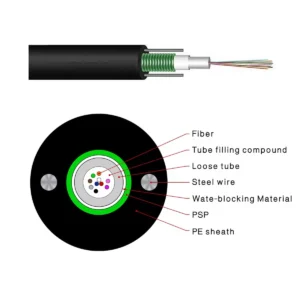

Description
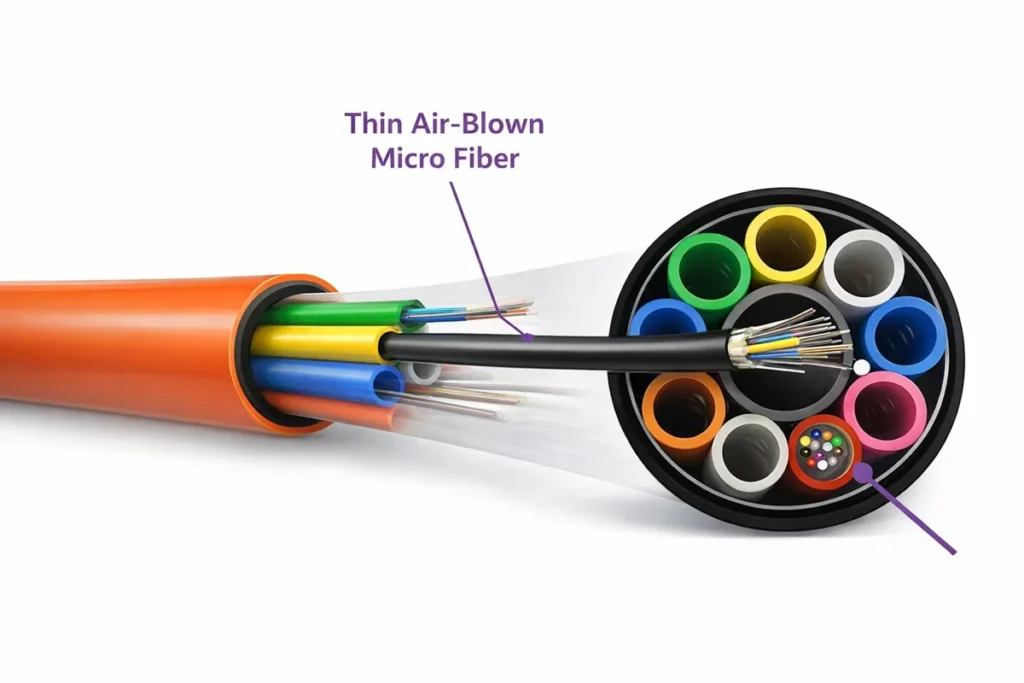
Product Overview
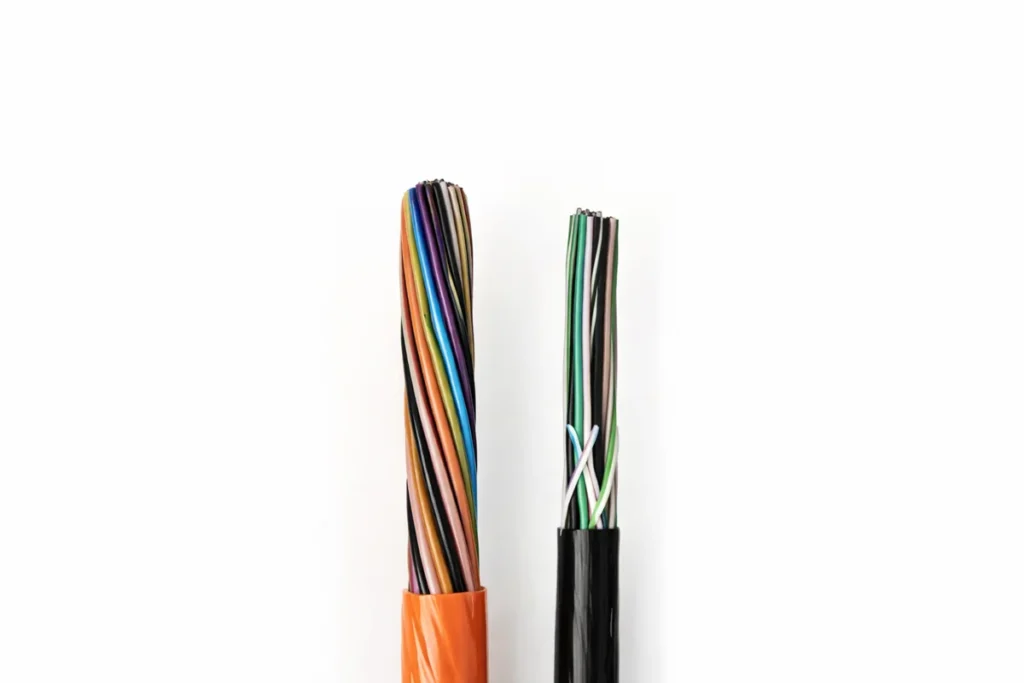
GCYFY is a lightweight, all-dielectric air-blown micro fiber optic cable optimized for microduct networks. The outer sheath uses a low-friction HDPE with surface grooves to enhance jetting performance, while gel-free construction speeds splicing and handling. Available as central-tube builds for 2–12 fibers and micro-distribution variants for higher counts. This technology is the preferred choice for future-proof FTTx networks in Europe, Southeast Asia, and advanced North American metropolitan areas.
Where it’s used
- FTTx last-mile and access distribution in duct plants
- Campus/backbone microduct systems where space is limited
- Upgradeable routes that require staged fiber additions
- Utility and SCADA microduct corridors
Why air-blown
- Reuses the same microducts for future capacity; cables can be blown out/in.
- Lower and more uniform installation stresses vs. pulling.
- High fiber density in very small ducts, reducing civil works and storage.
Specifications
A) Construction & Materials (typical)
| Item | Value | Notes |
|---|---|---|
| Cable type | GCYFY air-blown microcable | All-dielectric |
| Fiber types | G.652D,G.657A1/A2 | Bend-tolerant options |
| Central tube (2–12F) | PBT Ø1.5 mm,0.3 mm wall | Per central-tube spec |
| Strength member | Aramid yarn | Non-metallic |
| Outer sheath | Low-friction HDPE, black | Grooved surface for longer jetting |
| Overall OD (2–12F) | ≈2.5 mm | Typical central-tube build |
| Cable weight (2–12F) | ≈2.5 kg/km | |
| Sheath marking/lengths | Meter-marked; 1000–6000 m supply |
B) Optical (typ., single-mode)
| Parameter | Value |
|---|---|
| Attenuation @1310/1550 nm | ≤0.40/≤0.30 dB/km (cabled) |
C) Mechanical & Environmental (typical)
| Parameter | Value |
|---|---|
| Min. bend radius | 20D install / 10D static |
| Tensile (short) | 120 N (2–12F central-tube) |
| Crush | 1000 N/100 mm |
| Temperature (install/operate/store) | −10…+40 °C / −30…+50 °C / −40…+60 °C |
| Qualification tests | Tension/bend/crush and thermal cycling per IEC 60794; Δα ≤0.05 dB typical after tests |
D) Blowing Performance (reference, 5.0/3.5 mm duct)
| Fibers | Pressure | Typical distance | Typical time |
|---|---|---|---|
| 2–8F | 7–10 bar | 500–1000 m | 10–18 min |
| 12F | 7–10 bar | 500–800 m | 15–20 min |
| Test benches: Plumett UM25, Ericsson, Catway FBT-1.1. Actuals depend on duct path and equipment. |
E) Packaging (reference)
| Fiber count | Standard lengths | Pan size (Ø×H) | Gross weight |
|---|---|---|---|
| 2–4F | 2000/4000/6000 m | Ø510×200/300 mm | 8–13 kg |
| 6F | 2000/4000 m | Ø510×200/300 mm | 9–12 kg |
| 8F | 2000/4000 m | Ø510×200/300 mm | 9–14 kg |
| 12F | 1000–4000 m | Ø510×200/300 mm | 8–15 kg |
| Free-coiled pan packs for easy handling. |
Key Benefits
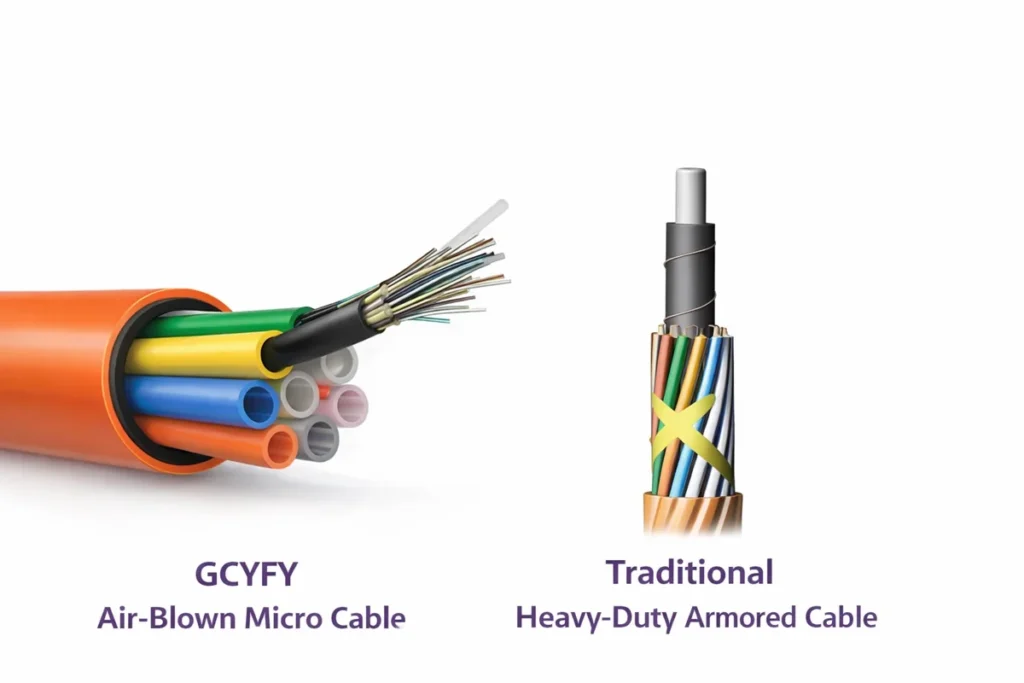
- Maximum fiber per duct: very small OD and gel-free design improve packing density and handling.
- Low-friction jacket with grooves: increases jetting distance and consistency.
- All-dielectric, aramid-reinforced: safe near power; no bonding/grounding.
- Fast deployment and upgrades: blow today, add capacity later using the same microducts
Ideal Deployment Scenarios
The GCYFY cable is specifically engineered for regions with established microduct infrastructure, widely adopted in:
- European FTTH Rollouts: Meeting stringent EU standards for high-density urban access networks.
- Southeast Asia Smart Cities: Ideal for rapid broadband upgrades in densely populated areas like Singapore and Kuala Lumpur.
- North American MDU & Campus Networks: Efficient for last-mile connections where conduit space is limited.
Options & Ordering
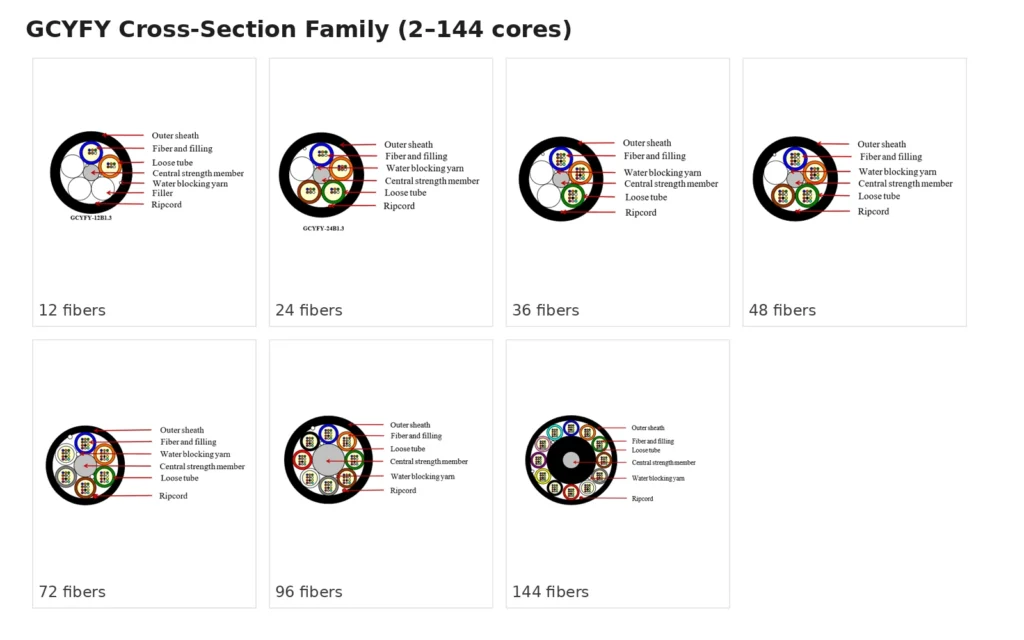
- Fiber counts: 2,4,6,8,12 central-tube; higher counts (24–144) available as micro-distribution/stranded variants on request.
- Jacket color/marking: black standard; meter marks per reel.
- Reel lengths: 1–6 km typical; custom cuts available.
Ordering code example: GCYFY–12F–OS2–Ø2.5–HDPE–Black–L4000m
(Confirm duct I.D., blowing kit, route length, and splicing plan at RFQ.)
FAQ
Q1. What duct size is recommended?
5.0/3.5 mm microducts are validated for 2–12F central-tube builds; consult us for larger counts and bundle ducts.
Q2. How far can I blow a 2–8F cable in one shot?
With 7–10 bar and clean 5/3.5 mm ducts, 500–1000 m is typical; 12F achieves ~500–800 m under similar conditions.
Q3. Is the cable gel-free?
Yes—resin-coated fibers and dry construction simplify splicing and cleaning.
Q4. What are the basic mechanical limits?
120 N short-term tensile, 1000 N/100 mm crush, and bend radius 20D/10D (install/static) for typical 2–12F builds.