

Description
Overview (What it is)
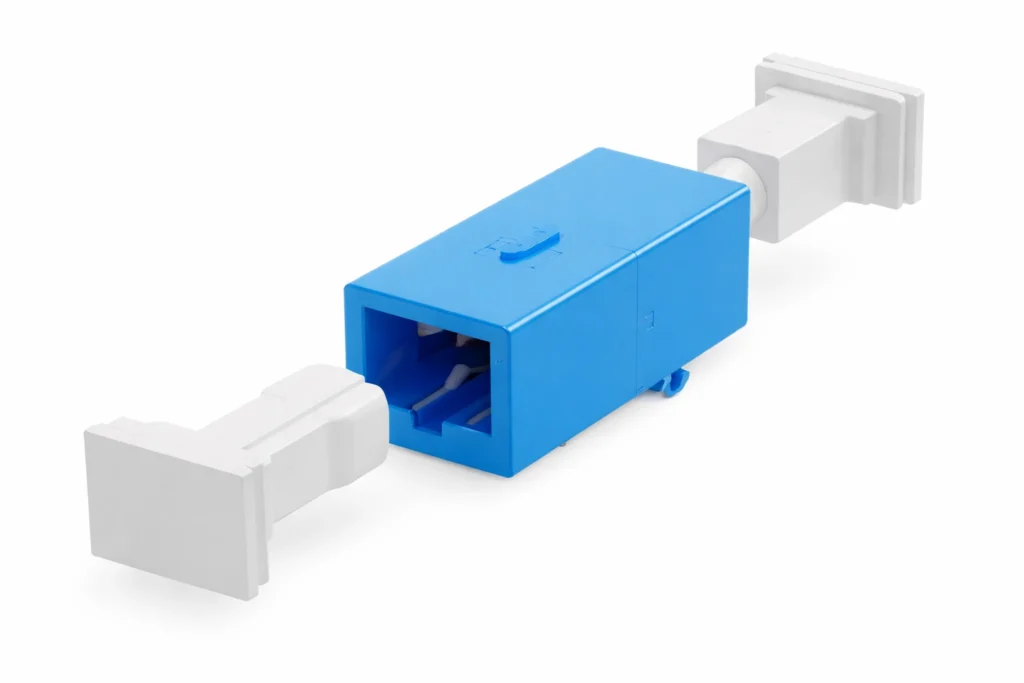
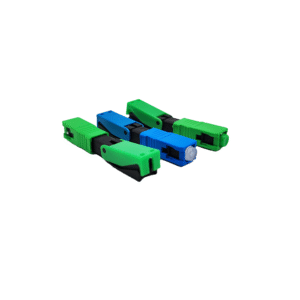
A Photoelectric Composite Connector & Adapter is a hybrid coupler that enables optical signal + DC power to be connected through one interface in FTTR (Fiber-to-the-Room) deployments.
It provides a clean, standardized demarcation/mating point between hybrid patch cords, hybrid trunk cables, and PoF-enabled FTTR devices (room APs, optical panels, terminals, or PoF nodes) — reducing indoor wiring complexity while improving installation repeatability.
If your FTTR design requires both stable backhaul and power delivery to room-level devices, this adapter helps you achieve a “one-cable, one-connector” installation approach.
Why FTTR teams choose hybrid fiber + power adapters
In real FTTR retrofits, most delays and rework come from:
- Needing both fiber routing and separate power routing
- Limited AC outlets near ceiling corners / weak-current boxes
- Aesthetic requirements (no trunking, no visible cables)
- Complex onsite termination and unstable workmanship quality
A hybrid adapter simplifies the handoff point and supports consistent site standards across large-scale FTTR rollouts.
Key Features
- Low insertion loss, high return loss for stable FTTR optical performance
- High conductivity & high voltage resistance, designed for hybrid power delivery
- Integrated safety protection design for indoor power supply scenarios
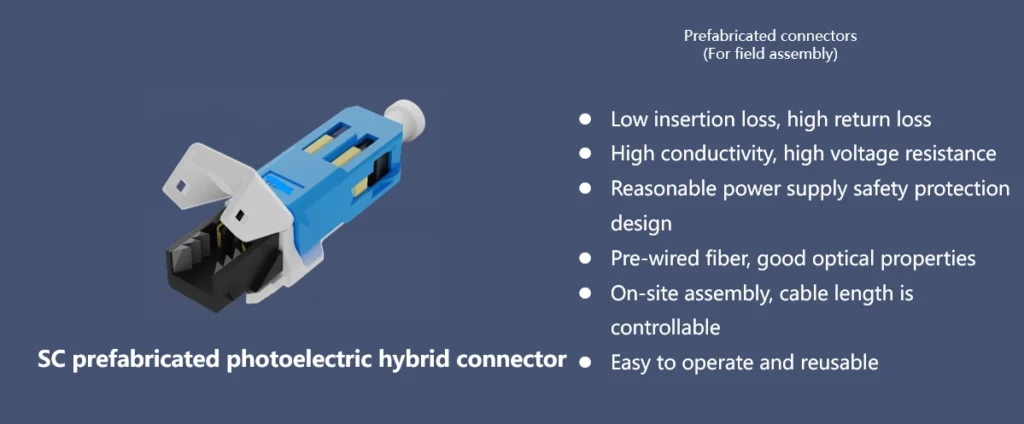
- Pre-embedded optical fiber path ensures reliable optical performance
- On-site assembly supported and cable length is controllable for installers
- Easy to operate, reusable, suitable for repeated mating in maintenance cycles
- Standardized interfaces for better interchangeability and site standardization
- Wide operating temperature range for stable performance in different indoor environments
Product Variants (Interfaces)
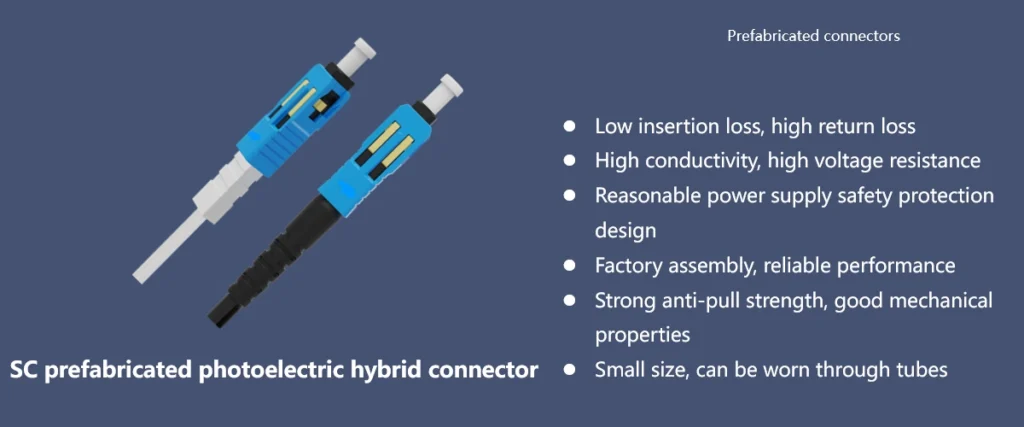
We offer two mainstream interface options used in FTTR hybrid ecosystems:
Connector and adapter Models
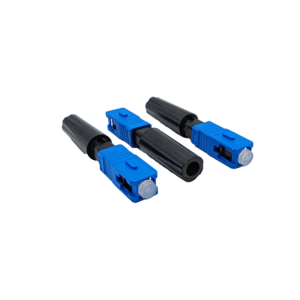
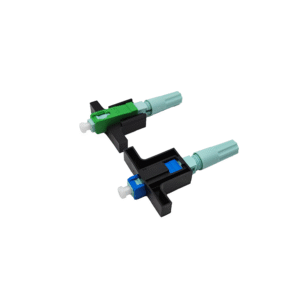
- AMCC-2301-SC/UPC — Photoelectric Composite Connector and Adapter (SC/UPC)
- AMCC-2302-XC/UPC — Photoelectric Composite Connector and Adapter (XC/UPC)
Matching Hybrid Plug / Connector
- AMCC-2351-SC — Optical Power Composite Connector (SC type)
Notes for buyers: SC/UPC is widely used for FTTR indoor distribution; XC/UPC is selected when your system standard requires XC interface. If you’re unsure, send us your device/ODN interface requirement and we will match the correct option.
Technical Specifications (Typical Performance)
Below are typical parameters for our SC-type photoelectric composite connector family used in FTTR hybrid patching. If you need an XC detailed datasheet, we can provide it based on your project standard.
| Parameter | Specification |
|---|---|
| Optical polish type | UPC |
| Insertion loss (IL) | ≤ 0.3 dB |
| Return loss (RL) | ≥ 50 dB |
| Contact resistance | ≤ 30 mΩ |
| Withstand voltage | ≥ 1500 V (DC) / 1 min (no breakdown, no arc) |
| Insulation resistance | ≥ 500 MΩ / 500 V (DC) |
| Rated current | 0.5 A |
| Mating durability | ≥ 1000 cycles |
| Tensile strength | ≥ 70 N |
| Operating temperature | -20°C to +70°C |
| Storage temperature | -40°C to +70°C |
Supported cable ecosystem (typical):
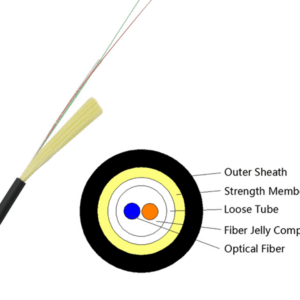
- Hybrid optical-electrical indoor cables (commonly “butterfly/flat” hybrid structures)
- Fiber type commonly used: G.657A series for FTTR bends (other options available by request)
Typical Applications (Where it fits)
This adapter is designed for FTTR indoor distribution where a single cable must deliver both connectivity and power:
- FTTR room AP power + fiber backhaul
- Indoor optical panels / FTTR distribution boxes
- Smart home / hospitality networks (hotel rooms, serviced apartments)
- Enterprise indoor networks: offices, hospitals, banks, parks, campuses
- Rapid deployment scenarios where consistent workmanship is critical
How it improves installation (Installer-focused)
Compared to “fiber + separate power” routing, the hybrid adapter approach helps:
- Reduce cable clutter and simplify routing paths
- Standardize handoff points for faster acceptance and maintenance
- Minimize wiring mistakes and reduce rework rate
- Improve site aesthetics (important for premium residential retrofits)
- Enable faster, repeatable rollouts across hundreds or thousands of homes
Installation Guidance (Recommended workflow)
- Confirm required interface: SC/UPC or XC/UPC
- Route the hybrid cable with bend control and proper fixation
- Clean and inspect the optical end-face before mating
- Plug the hybrid connector into the adapter until fully seated
- Verify optical link (IL/RL) and power continuity at the endpoint device
- Label the outlet/port for future maintenance
Ordering Information (How to specify)
To quote quickly, please share:
- Interface type: SC/UPC adapter or XC/UPC adapter
- Quantity per project and target delivery schedule
- Mating side requirement (adapter only / adapter + plug / full hybrid patch cord set)
- OEM requirements: logo / labeling / packaging
- Any local compliance requirement (RoHS, etc.)
As a direct manufacturer, we support:
- Stable bulk supply
- OEM branding and packaging
- Consistent QC from materials to final assembly
Quality & Compliance
We understand FTTR projects are judged by consistency and failure rate, not just price. Our hybrid connector system is designed to support scalable deployment with predictable performance.
Applicable standards (typical reference):
- YD/T 4305.1-2023 Communication optical and electrical hybrid active connectors (SC type)
- IEC 61754-4 Fiber optic connector interfaces (SC type)
- RoHS substance limitation requirement (project-based compliance support)
Project support available:
- Optical test records (IL/RL)
- Electrical safety checks (insulation / withstand voltage)
- OEM identification and batch traceability options
FAQ
1) What’s the difference between SC/UPC and XC/UPC for FTTR?
SC/UPC is widely adopted for indoor FTTR distribution due to compatibility and availability. XC/UPC is selected when your FTTR ecosystem is standardized on XC interface. Tell us your device/port requirement and we’ll match the correct version.
2) Can I use this hybrid adapter with a normal SC fiber adapter?
No. A normal SC adapter only supports optical mating. A photoelectric composite adapter is designed for optical + power contacts and safety structure.
3) What optical performance should I expect in a typical FTTR link?
Typical insertion loss is ≤0.3 dB and return loss ≥50 dB for UPC interfaces (cleaning and proper handling are critical to maintain performance).
4) Is the adapter reusable?
Yes. The design supports repeated mating and maintenance cycles; typical durability is ≥1000 cycles.
5) What power rating does it support?
Typical rated current is 0.5 A. If your system requires different power levels, share your PoF device spec and we will confirm the suitable configuration.
6) Is this for outdoor use?
This adapter family is primarily positioned for indoor FTTR. If you need outdoor-rated solutions, please specify IP requirement and environment conditions.
7) Do you provide OEM branding?
Yes. We support OEM logo/labeling/packaging and stable supply for rollout projects.
8) Can you supply the full solution (adapter + plug + hybrid patch cord / hybrid trunk)?
Yes. We can provide adapter, matching plug, and pre-terminated hybrid cable assemblies as a full kit for standardized deployment.