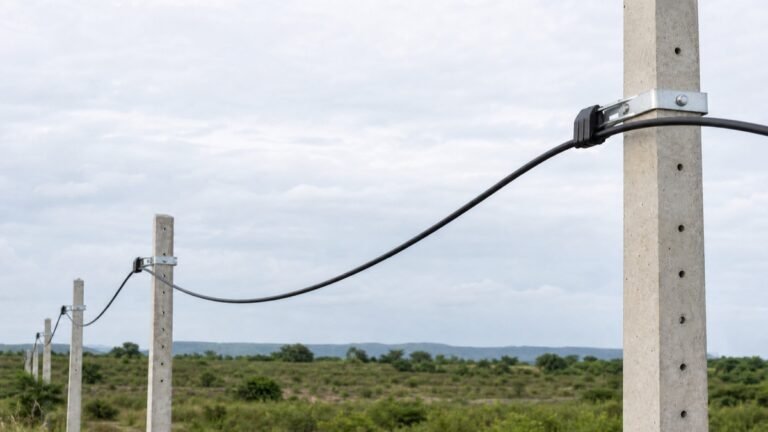
ADSS (All-Dielectric Self-Supporting) cable is the standard choice for aerial fiber deployment on power line towers and utility poles — but only when correctly specified. Wrong span length selection, underestimated wind loading, or incorrect sag design leads to cable failure and outages. This guide gives telecom engineers the specification framework to get it right.
What Is ADSS Fiber Optic Cable?
ADSS cable is a fully dielectric (non-metallic) self-supporting aerial fiber cable designed for installation on power transmission towers and distribution poles.
- All-dielectric: No metallic elements — safe on high-voltage lines, no grounding required
- Self-supporting: Aramid (Kevlar) strength members span between poles without a separate messenger wire
- Outdoor-rated: UV-resistant PE jacket (or AT jacket for high-voltage environments)
- High fiber count: Available from 12F to 144F (288F+ on request)
Span Length Classification
| Class | Rated Span | Typical Application |
|---|---|---|
| Light Duty | 50–100 m | Urban distribution, short spans |
| Medium Duty | 100–200 m | Suburban distribution lines |
| Heavy Duty | 200–400 m | Rural distribution, transmission |
| Ultra-Heavy | 400–600 m | Long-span transmission lines |
| Custom | 600–1200 m | River crossings, mountain terrain |
Sag Calculation Fundamentals
ADSS cable forms a catenary curve between support points. The relationship between span, sag, and tension:
Sag (m) = (W × L²) / (8 × T)
Where: W = cable weight per meter (N/m), L = span length (m), T = horizontal tension (N)
Target Sag by Span
| Span Length | Typical Sag (%) | Clearance Priority |
|---|---|---|
| 50–100 m | 1.5–2.5% | Road crossing, building clearance |
| 100–200 m | 2.0–3.0% | Electrical safety clearance |
| 200–400 m | 2.5–4.0% | Ground clearance, ice loading |
| 400–600 m | 3.0–5.0% | Terrain clearance, wind galloping |
Wind Load Design: IEC 60826
Reference wind pressure formula: q = ½ × ρ × V² × Cd
Where: ρ = 1.225 kg/m³ (air density at sea level), V = design wind speed (m/s), Cd = 1.0–1.2 for cylindrical cables
Wind Load Zones
| Zone | Design Wind Speed | Reference Pressure | Typical Region |
|---|---|---|---|
| Low Wind | ≤ 25 m/s | ≤ 380 Pa | Low-wind inland |
| Medium Wind | 26–35 m/s | 380–750 Pa | Most of China, Europe interior |
| High Wind | 36–45 m/s | 750–1240 Pa | Coastal, typhoon zones |
| Very High Wind | 46–60 m/s | 1240–2200 Pa | Typhoon/hurricane exposure |
Ice Loading
In ice-prone climates, combined ice+wind loading is the governing design case. Standard ice load assumptions:
- Light ice zone: 5 mm radial ice, 700 kg/m³ density
- Medium ice zone: 10–15 mm, combined with 50% wind
- Heavy ice zone: 20–30 mm, combined with reduced wind
A 200m span designed for wind-only may fail under combined ice+wind if undersized. Always check the governing load combination.
Cable OD vs Span Relationship
| Fiber Count | Typical OD (mm) | Weight (kg/km) | Max Span at 25 m/s |
|---|---|---|---|
| 12F–24F | 11–13 mm | 95–120 kg/km | 200–400 m |
| 48F–72F | 13–16 mm | 120–160 kg/km | 150–300 m |
| 96F–144F | 16–19 mm | 160–200 kg/km | 100–200 m |
Larger cable diameter = more wind surface area = greater tension requirement. Specify minimum necessary fiber count to minimize OD and cost.
AT Jacket vs PE Jacket Selection
| Jacket Type | Application | Voltage Threshold |
|---|---|---|
| PE (Standard) | Distribution lines, low voltage | Up to 35 kV |
| AT (Anti-Tracking) | Transmission lines, high voltage | 35–500 kV |
Rule: if the cable attachment point is within 15m of a bare conductor at 110 kV+, specify AT jacket.
ADSS Procurement Specification Checklist
- Maximum span length (meters) — design span, not average
- Design wind speed (m/s) or reference wind pressure (Pa)
- Ice loading zone (if applicable)
- Required fiber count and fiber type (G.652D or G.657A1)
- Jacket type: PE or AT (based on line voltage)
- Minimum Rated Tensile Strength (RTS): typically 15–40 kN
- Installation temperature range
- Certifications: IEC 60794-1/60794-4, GB/T 17737.1, or Bellcore GR-20
AIMIFIBER ADSS Cable Range
- Fiber count: 12F, 24F, 36F, 48F, 72F, 96F, 144F
- Fiber type: G.652D (standard SMF) and G.657A1 (bend-insensitive)
- Jacket: Standard PE or AT anti-tracking PE
- Rated Tensile Strength: 8 kN, 12 kN, 20 kN, 30 kN, 40 kN
- Certifications: IEC 60794-1-2, IEC 60794-4, GB/T 13993.3
- MOQ: 1 drum (typically 2–4 km)
Send your span data, line voltage, and wind zone to AIMIFIBER for a custom cable specification with sag-tension calculations. Response within 24 hours.
Request ADSS Specification →