ADSS Cable Span Selection: 100m vs 150m vs 200m

ADSS cable span selection should start with the longest pole-to-pole distance, but it cannot end there. A 100m, 150m, or 200m label is only an initial design class. Wind, ice, temperature, cable weight, allowable sag, attachment height, pole strength, fibre count, and hardware can change the required construction.
This guide helps buyers screen the three common span classes and prepare a specification that a cable engineer can verify.
Technical review: Sophie at AIMIFIBER handles B2B fibre optic project inquiries and specification coordination. This article separates catalogue screening from the route-specific engineering data required before quotation.
Quick answer: which ADSS span class should you start with?
Use the longest individual span on the route as the first screening value. Then check the governing environmental and mechanical loads.
| Nominal span class | Typical first-pass use | What usually becomes more important | Do not approve until you have checked |
|---|---|---|---|
| 100m | Short distribution routes and closely spaced telecom poles | Cable economy, installation handling, local wind load | Sag, clearance, pole capacity, matching clamps |
| 150m | Mixed rural or suburban aerial routes | Balance of cable weight, tensile capacity, and sag | Maximum route span, wind/ice case, installation temperature |
| 200m | Longer open sections, crossings, or wider pole spacing | Higher mechanical load and tighter clearance control | Route profile, sag-tension table, hardware rating, safety factors |
These are screening categories, not universal performance guarantees. A severe wind or ice case can make a nominally short route more demanding than a longer route in mild conditions.
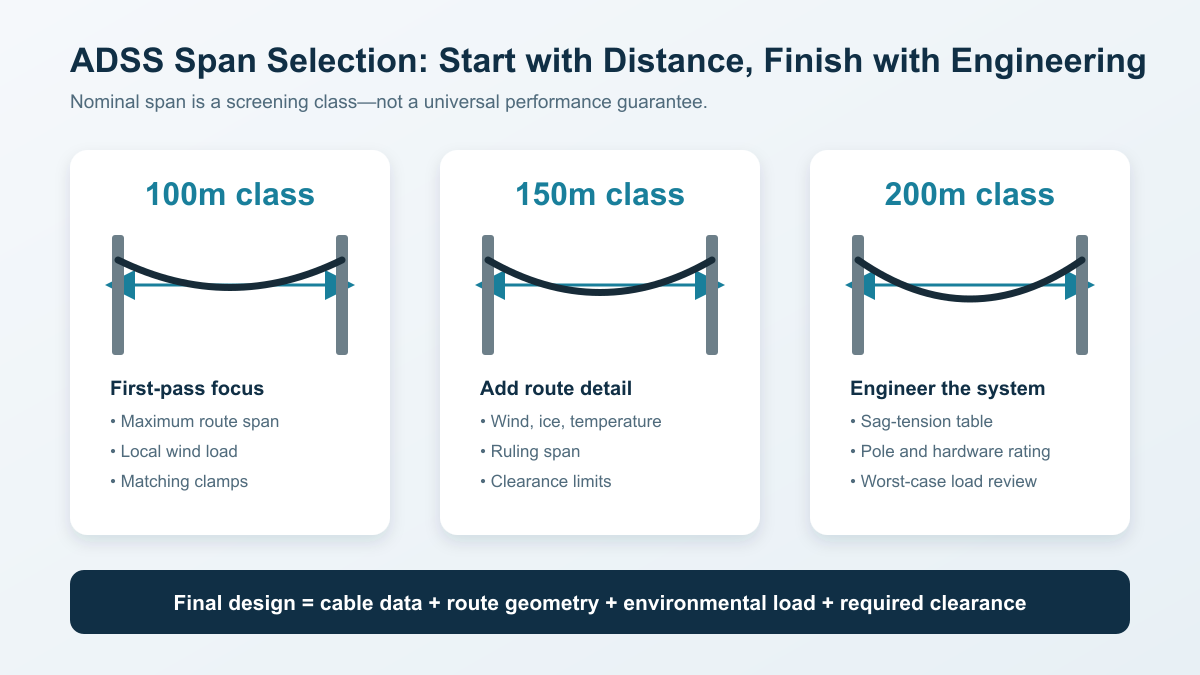
Use nominal span as the first filter. Final approval still needs route loading and sag-tension checks.
For a route-specific design, review the AIMIFIBER outdoor fiber optic cable range and send the project inputs listed below.
What “span” means in an ADSS specification
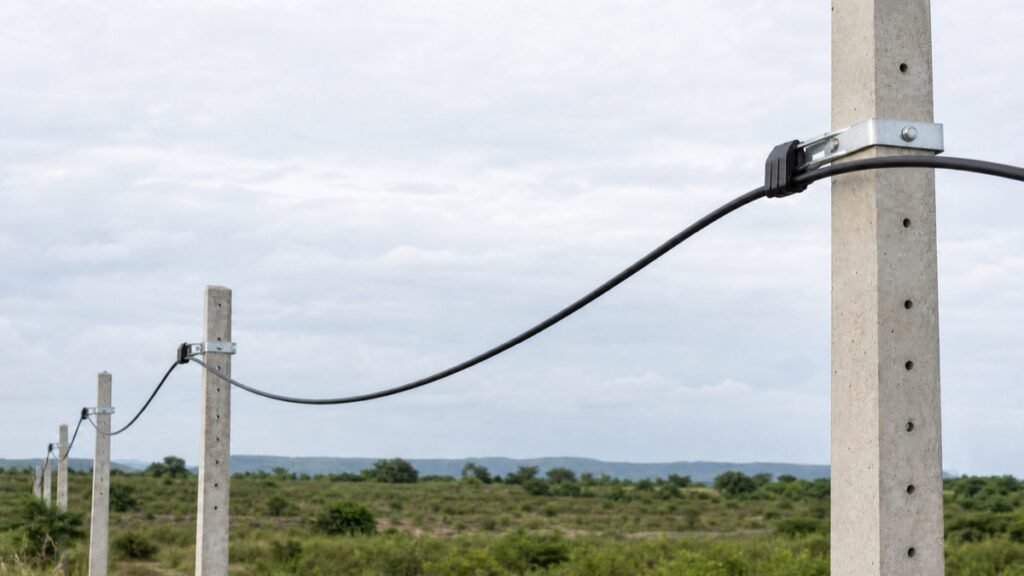
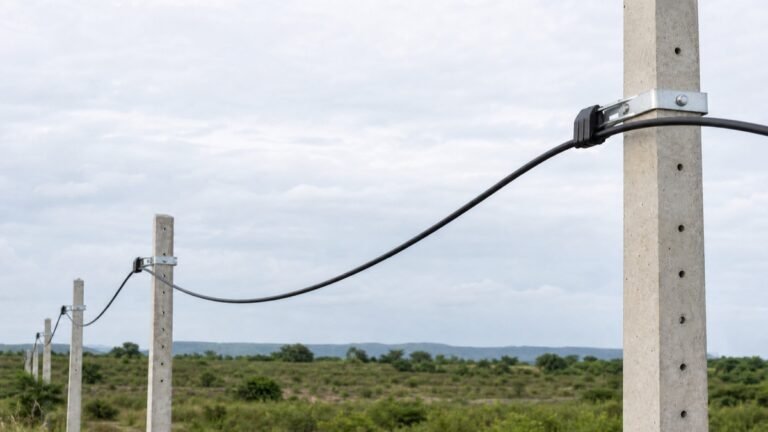
ADSS means All-Dielectric Self-Supporting cable. It uses non-metallic strength members to support its own weight between poles or towers. It does not need a separate steel messenger.
If the route includes buried or duct sections as well as aerial spans, compare the other outdoor fiber optic cable constructions before standardizing the whole route on ADSS.
The span is the horizontal distance between two support points. On a real route, three values may matter:
- Average span: useful for route summaries, but not enough for cable approval.
- Maximum span: the longest individual section and the first value to flag in an RFQ.
- Ruling span: an engineering value used to represent a group of spans for sag-tension work.
A route with mostly 90m sections and one 178m road crossing should not be quoted as a simple “100m span project.” The crossing needs separate review, and it may control the cable or hardware design.
Why span length alone is not enough
Corning's ADSS installation procedure says span tension is calculated for each cable to accommodate maximum wind and ice loads. Its required inputs include span length, loading conditions, installation temperature, and fibre count. That is why a supplier should not confirm a design from “24-core, 150m span” alone.
Prysmian's published ADSS data provides a useful reality check. One cable construction has different computed maximum spans under the same NESC Medium climatic category when the permitted sag changes. Cable construction, loading case, and sag work together.
A 150m installation-sag screening example
Corning's procedure uses 1% installation sag for its Solo ADSS cable. Applied as a simple screening check to a 150m level span:
Initial installation sag = 150m × 1% = 1.5m
This number does not approve a 150m cable or define its final field tension. The engineer still needs the proposed cable's weight and stress-strain data, plus wind, ice, temperature, clearance and pole information. A supplier that quotes the final tension from “150m span” alone is missing the governing inputs.
For level-span screening, the familiar parabolic relationship is H = wL² / 8f, where H is horizontal tension, w is cable load per metre, L is span and f is sag. In this example, L and f are known, but w must come from the exact proposed cable data sheet. Final design should use the manufacturer's sag-tension calculation rather than this simplified relationship.
1. Wind and ice loading
Wind adds transverse load. Ice adds weight and increases the cable's projected area. Combined loading raises tension and can increase sag or overload the cable, poles, and fittings.
Send the governing wind speed and radial ice thickness from the project standard. If the project uses NESC loading districts or a national utility standard, state the exact category rather than writing “normal weather.”
2. Temperature range
Installation temperature affects the initial tensioning target. The operating temperature range affects the final sag and clearance checks.
Give the project's minimum and maximum temperatures, plus the expected installation temperature. Do not copy a generic temperature range from another tender unless the routes share the same conditions.
3. Sag and clearance
More sag generally reduces tension, but it also reduces clearance. Less sag increases tension and demands more from the cable, attachment hardware, and supporting structures.
The acceptable value depends on road, ground, conductor, and communication-space clearances. Local codes and the pole owner's rules govern the final attachment position.
4. Fibre count and cable construction
Fibre count can change the cable diameter and weight. The required tensile design changes the quantity of aramid yarn and may affect the jacket and internal structure.
Ask for a data sheet for the exact proposed configuration. It should identify at least cable diameter, cable weight, maximum installation tension, maximum allowable tension, rated tensile strength, minimum bend radius, and operating temperature range.
5. Pole line geometry
Angle poles, elevation changes, long crossings, and unequal adjacent spans change the mechanical case. Pole strength and guying must also be checked.
If the route contains sharp turns or major grade changes, mark them on the route profile. Do not hide them inside an average-span figure.
100m span ADSS cable: when it is the sensible starting point
A 100m class is often the practical first option for short aerial distribution routes. The poles are relatively close, and route geometry is usually easier to manage.
It is not automatically a “light-load” application. Coastal wind, mountain exposure, heavy ice, a low attachment point, or weak poles can still control the design.
Use a 100m starting class when:
- The longest normal span is at or below 100m.
- There are no longer road, river, or valley crossings hidden in the route.
- The project loading case and required clearance have been defined.
- The proposed suspension and dead-end hardware matches the cable diameter and load.
Do not substitute a lower-cost short-span cable until the sag-tension sheet has been checked for the worst span.
150m span ADSS cable: the middle class needs real route data
The 150m class is common in rural and mixed pole routes, but it should not be selected by rounding an average span upward.
For example, a route averaging 112m may still include several spans above 150m. It may also include an exposed hillside where the wind case governs. Both facts belong in the RFQ.
Before approving a 150m design, confirm:
- Maximum individual span and ruling span.
- Wind, ice, and temperature cases.
- Required minimum clearance at the worst span.
- Pole attachment height, angles, and elevation changes.
- Cable and hardware mechanical ratings.
This is the point where a route spreadsheet or profile drawing saves time. A one-line request such as “48F ADSS, 150m” usually causes a second round of technical questions.
200m span ADSS cable: treat it as an engineered system
A 200m class puts more emphasis on cable tensile performance, sag control, and hardware compatibility. The cable, suspension clamps, dead-end sets, dampers, pole fittings, and supporting structures must be reviewed as one system.
For longer or exposed spans, request a project-specific sag-tension table. It should cover the required temperature and weather load cases. The selected hardware must match the cable's outside diameter and mechanical load.
Do not reduce sag in the field by simply pulling harder. Corning distinguishes maximum pulling tension during installation from final span tension and warns installers not to exceed the cable specification or pole and hardware capacity.
If only one or two route sections approach 200m, ask whether they should use a separate cable section or a special structure. One expensive crossing should not automatically dictate every reel on the route.
What a real AIMIFIBER ADSS specification review looks like
In 2021, AIMIFIBER reviewed an overseas buyer's point-by-point requirements for 36F and 96F G.652D ADSS cables with a 100m nominal span. The exercise is useful because the two cables shared the same span class but did not share the same physical construction.
| Reviewed field | 36F evaluated configuration | 96F evaluated configuration |
|---|---|---|
| Fibre type | G.652D single-mode | G.652D single-mode |
| Nominal span | 100m | 100m |
| Evaluated cable diameter | 11.6 ± 0.4mm | 12.5 ± 0.5mm |
| Evaluated outer jacket thickness | 1.6 ± 0.2mm | 1.6 ± 0.2mm |
| Loose-tube arrangement | 3 tubes × 12 fibres | 8 tubes × 12 fibres |
| Loose-tube diameter | 2.4mm | 2.4 ± 0.1mm |
| Central strength member | FRP, 2.6mm | FRP, 4.0mm |
| Ripcords | 2 red ripcords | 2 red ripcords |
These values are from an anonymized project-specific technical response, not a universal AIMIFIBER catalogue specification. They show why fibre count changes diameter, tube layout and strength-member design even when the nominal span remains 100m. A new project must be checked against its own loading and route conditions.
The ADSS data sheet fields buyers should compare
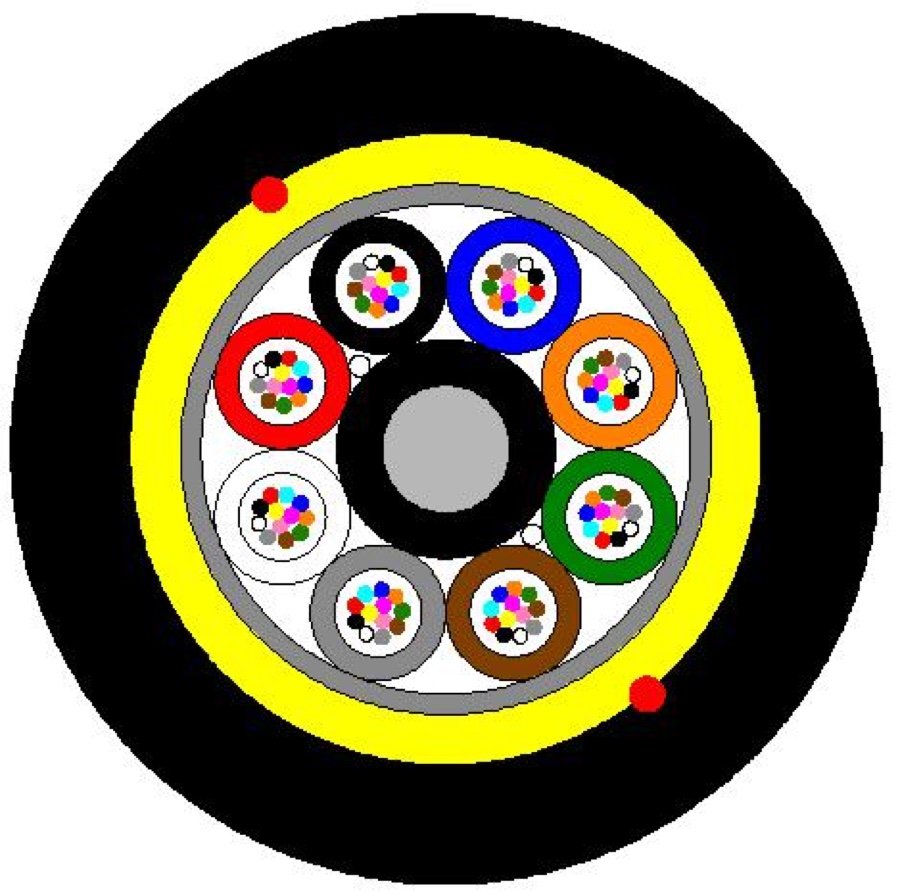
AIMIFIBER 96F ADSS construction drawing from the same 2021 technical evaluation. The final structure depends on the route and project specification.
| Field | Why it matters | Buyer check |
|---|---|---|
| Maximum installation tension / MIT | Limits pulling and installation load | Confirm units and installation method |
| Maximum allowable tension / MAT | Governs the worst service load considered by the design | Match it to the route load case |
| Rated tensile strength / RTS | Indicates the cable's ultimate mechanical rating | Do not use RTS as normal working tension |
| Cable weight | Direct input to sag and tension | Use the exact fibre-count construction |
| Outside diameter | Affects wind load, bend radius, and clamp sizing | Match every fitting to the stated diameter |
| Minimum bend radius | Protects the cable during and after installation | Check loaded and unloaded values separately |
| Temperature range | Defines installation and service limits | Compare with route extremes |
| Jacket type | Supports the intended electrical and environmental placement | Confirm with the utility's electric-field study where relevant |
The exact abbreviations and definitions can vary by manufacturer. Compare definitions, test methods, and units before comparing numbers. For ADSS used along power lines, IEC 60794-4-20:2018 is the current family specification listed by IEC. Self-supporting aerial telecom cables outside that high-voltage scope may instead fall under IEC 60794-3-20. Confirm which standard the tender actually requires.
A practical ADSS RFQ checklist
Send this information with the inquiry:
Route
- Total route length
- Average, maximum, and ruling span if available
- Span schedule or route profile
- Pole or tower type, attachment height, and major angle points
- Road, river, railway, or valley crossings
Environment
- Maximum wind speed and the referenced standard
- Radial ice thickness or loading district
- Minimum, maximum, and installation temperatures
- Altitude and severe pollution or coastal exposure, if applicable
Cable
- Fibre count and fibre type
- Required standards and test reports
- Jacket requirement
- Drum length limits
- Cable marking and packaging requirements
Mechanical and installation
- Required sag or minimum clearance
- Installation method and pulling limits
- Suspension, dead-end, damper, and down-lead hardware requirements
- Any buyer-defined safety factor or utility specification
If several fields are unknown, send the route drawing and local design standard. AIMIFIBER can identify the missing inputs before preparing the final data sheet.
For general ordering, customization, and outdoor-cable questions, see the AIMIFIBER technical FAQ.
Common buying mistakes
Specifying only the average span
Average span hides crossings and outliers. State the maximum individual span and attach a span schedule.
Treating 200m cable as a universal upgrade
A higher nominal span class may add cost, diameter, or weight. It still needs compatible fittings and pole checks. Buy the design the route requires, not the largest label in a catalogue.
Comparing price per kilometre before comparing construction
Two “48F 150m ADSS” quotations may use different load assumptions, aramid quantities, diameters, jackets, and test requirements. Normalize the technical data first.
Buying clamps separately from the cable data
Suspension and dead-end fittings must match cable diameter and load. A generic fitting description is not enough.
Using a generic sag percentage without checking clearance
Sag is an engineering result, not a visual preference. The final value must satisfy tension and clearance requirements across all load cases.
Frequently asked questions
Can I use a 200m ADSS cable on a 100m span?
Possibly, but that does not make it the best commercial or mechanical choice. Confirm the cable, sag-tension setting, clamps, and poles for the actual 100m route. A higher nominal span rating is not permission to ignore installation data.
Is the maximum span printed on a data sheet guaranteed for every climate?
No. Maximum span is tied to defined cable, sag, and loading conditions. Ask for the assumptions behind the stated value and compare them with the project standard.
What is the difference between installation tension and span tension?
Installation tension is the load applied while pulling or placing the cable. Span tension is the final tension after the cable is set in its support hardware. Both must stay within the limits for the exact cable and installation plan.
Do fibre count and cable diameter affect span selection?
Yes. They can change weight, wind area, mechanical construction, bend radius, and clamp sizing. Use the data sheet for the exact fibre count, not a nearby model.
When should I request a sag-tension table?
Request one whenever the route has long spans, strict clearance, severe wind or ice, major elevation changes, or utility-specific design rules. For a 200m class project, it should be treated as a normal engineering deliverable.
What should I send AIMIFIBER for a quotation?
At minimum: fibre count, total length, maximum span, span schedule if available, wind, ice, temperature, attachment height, required clearance, jacket requirement, and installation standard.
Sources and engineering references
- Corning: Installation of Solo ADSS All-Dielectric Self-Supporting Fiber Optic Cables — installation tension, span-tension inputs, bend radius, route planning, and hardware.
- Prysmian: ADSS Optical Fibre Cable TC09421 — example of MIT, MAT, RTS, bend radius, temperature, and computed span data on one manufacturer data sheet.
- IEC 60794-4-20 — ADSS family specification for aerial optical cables along electrical power lines; use the current edition and national adoption required by the contract.