LC, SC, and FC are the three most common fiber optic connector types in active networks today. The right choice depends on your equipment, installation environment, and density requirements. This guide gives procurement teams and network engineers a direct, spec-based comparison to eliminate guesswork when specifying patch cords, pre-terminated cables, or pigtails.
Quick Comparison: LC vs SC vs FC
| Feature | LC (Lucent Connector) | SC (Subscriber Connector) | FC (Ferrule Connector) |
|---|---|---|---|
| Ferrule Diameter | 1.25mm | 2.5mm | 2.5mm |
| Connector Size | Small (SFF) | Standard | Standard |
| Coupling Mechanism | Push-pull latch | Push-pull latch | Threaded screw |
| Insertion Loss (typical) | <0.3dB | <0.3dB | <0.3dB |
| Return Loss (UPC) | >50dB | >50dB | >45dB |
| Return Loss (APC) | >60dB | >60dB | >60dB |
| Vibration Resistance | Moderate | Moderate | High (threaded) |
| Density (per 1U panel) | Up to 96 ports | Up to 48 ports | Up to 24 ports |
| Dominant Use Case | Data center, SFP modules | FTTH, enterprise LAN | Telecom, test equipment |
LC Connector: When to Use It
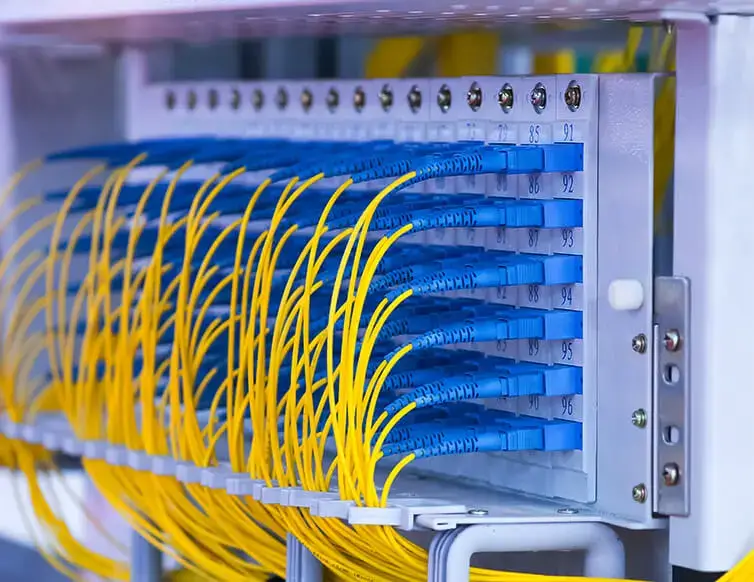
LC is the dominant connector in modern data centers and SFP/SFP+/QSFP ports. Its 1.25mm ferrule allows twice the port density compared to SC in the same panel space. If your switches and transceivers use LC ports — which virtually all SFP+ and QSFP28 modules do — LC is the correct choice.
Use LC when:
- Connecting to SFP, SFP+, SFP28, or QSFP modules
- You need maximum port density in patch panels
- Installing data center or enterprise switch infrastructure
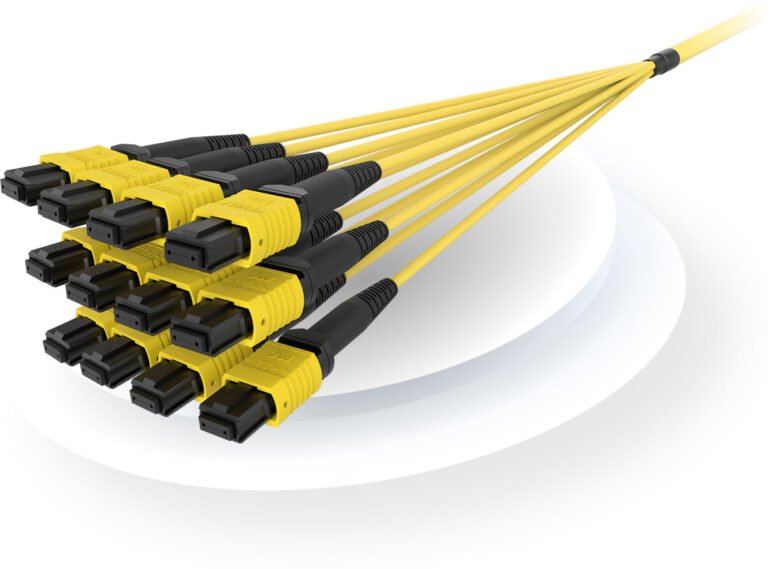
- Using MPO-to-LC breakout harnesses
SC Connector: When to Use It
SC was the standard before LC became dominant. It remains widely used in FTTH (Fiber to the Home) networks, particularly with SC/APC connectors for PON systems, and in legacy enterprise networks. The SC/APC (angled 8-degree polish) delivers superior return loss for passive optical networks where reflected light causes signal degradation.
Use SC when:
- Deploying FTTH subscriber drop connections (SC/APC is the standard)
- Working with OLT/ONT equipment that has SC ports
- Replacing or extending existing SC-based legacy networks
- Splitter connections in GPON/XGS-PON distribution networks
FC Connector: When to Use It
FC connectors use a threaded coupling mechanism that locks securely and resists vibration-induced disconnection. This makes FC the preferred choice in environments with mechanical vibration, or in test and measurement equipment where accidental disconnection would compromise measurements. FC is rarely used in new data center deployments but remains common in telecom central offices, military, and laboratory settings.
Use FC when:
- Connecting to OTDR test ports (most OTDRs have FC/APC or FC/UPC)
- Installing in high-vibration environments (industrial, outdoor cabinets)
- Working with legacy telecom exchange or CO equipment
- Using spectral analysis or optical power meter equipment
UPC vs APC Polish: Critical Choice for Single-Mode
For single-mode fiber, you must also specify the polish type. Mixing UPC and APC connectors causes high insertion loss and permanent ferrule damage:
| Polish | End Face Angle | Return Loss | Use Case |
|---|---|---|---|
| UPC (blue) | 0° flat | >50dB | Data com, general single-mode |
| APC (green) | 8° angled | >60dB | FTTH PON, CATV, high-return-loss apps |
FAQ
Q: Can I connect an LC connector to an SC port with an adapter?
A: Yes, LC-to-SC hybrid adapters and patch cords exist. However, mixing connector types is a sign of poor network planning and should be avoided in new installations. Use the correct connector type for your equipment from the start.
Q: Which connector has the lowest insertion loss?
A: All three connectors achieve <0.3dB with proper manufacturing. The difference in insertion loss between LC, SC, and FC is negligible in practice. What matters more is the quality of the ferrule polish and end-face inspection — a poorly polished LC will outperform a correctly specified but badly terminated FC.
Q: Is LC connector more fragile than SC?
A: The smaller 1.25mm ferrule requires more careful handling, but LC patch cords from quality manufacturers are fully robust for normal data center use. The latch clip on LC connectors is sometimes cited as a failure point in dense cable environments — consider using LC connectors with tab-release tools in very high-density panels.
Q: What connector do I need for an SFP+ module?
A: All SFP, SFP+, SFP28, and most QSFP modules use LC duplex connectors. QSFP28-to-4xSFP28 breakout cables use LC on the breakout ends. Always confirm with your module datasheet, but LC is the safe default assumption for any SFP-family port.
AIMIFIBER manufactures patch cords and pre-terminated cables in LC, SC, FC, ST, MTP, and MPO configurations, with UPC and APC options available for all single-mode types. Request a quote with your exact connector spec and quantity.