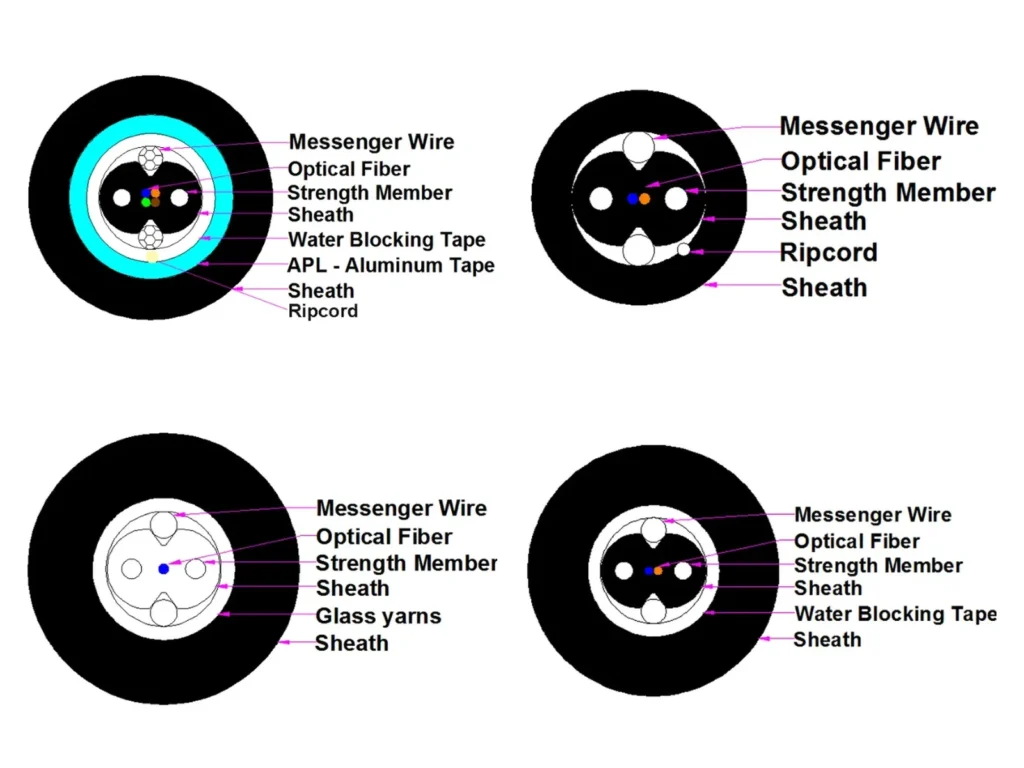
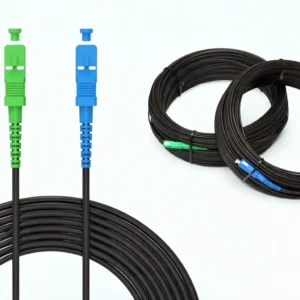
Heavy-duty round FTTH drop for underground ducts and rodent-risk zones. Inner butterfly drop wrapped by dry water-blocking tape and protected inside a round PE outer sheath. Ø7.0±0.3 mm profile reduces friction in conduits; optional Ø6.0 mm series available. Recommended with G.657A2 for tight-bend stability.
Heavy-duty round FTTH drop designed for underground ducts and rodent-risk routes. A cable-in-cable build places an inner butterfly drop inside a dry water-blocking layer and a rugged round PE sheath. Ø7.0±0.3 mm profile for low-friction pulls; optional Ø6.0±0.3 mm series. Recommended with G.657A2 for tight-bend stability.
Round, easy pulling: reduced wall contact and lower friction in conduits.
Moisture defense: longitudinal dry water-blocking limits water migration.
Rodent-resistant: thick PE outer jacket; optional deterrent yarns for high-risk areas.
Tight-bend optics: G.657A2 option maintains low loss in handholes and small-radius paths.
GJYXH03 is the duct specialist for last-mile builds. A standard GJXH butterfly core is isolated by a dry water-blocking layer and armored by a UV-resistant round PE sheath. The compact, smooth profile pulls cleanly through aged or rough conduits while protecting the optical unit against moisture, abrasion, and rodent activity.
Structure (Double Protection)
Inner core: GJXH-family butterfly drop (1F/2F) with FRP reinforcement
Outer jacket: round, UV-resistant PE, black; primary OD Ø7.0±0.3 mm (Ø6.0±0.3 mm optional)
Specifications
A) Dimensional & Materials
Item
Spec
Notes
Overall diameter
Ø7.0±0.3 mm (primary); Ø6.0±0.3 mm (optional)
Round profile for easier pulling
Construction
Cable-in-cable
Inner butterfly + dry water-blocking + round PE
Water blocking
Dry tape (longitudinal)
Limits water migration
Outer sheath
PE, UV-resistant, black
Rugged duct jacket
Inner core
GJXH butterfly drop
FRP strength members
Fiber type
OS2 G.657A2/G.657A1/G.652D
Recommend A2
Fiber count
1F / 2F
Others on request
Marking
Meter marks + print legend
Length control and QA traceability
B) Optical (Single-mode OS2)
Parameter
Spec
Notes
Attenuation
≤0.36 dB/km @1310/1383 nm; ≤0.23 dB/km @1550 nm
Typical FTTH duct performance
Bend performance
G.657A2 recommended
Stable in handholes/tight corners
C) Mechanical & Environmental
Parameter
Spec
Notes
Tensile load
≤350 N (short-term) / ≤150 N (long-term)
For sustained duct pulls
Crush resistance
≤1000 N/100 mm (short-term) / ≤300 N/100 mm (long-term)
Side-pressure tolerance
Minimum bend radius
Dynamic ≥30 mm / Static ≥15 mm (based on Ø7.0)
Use larger value for Ø7.0 series
Operating/storage
−40 °C to +70 °C
Underground environments
Installation temperature
0 °C to +70 °C
Use approved lubricant
Compliance
ITU-T G.657/G.652; IEC 60794-1; RoHS/REACH
Project-ready
D) Interface & Options
Item
Spec
Notes
Cable ends
Bulk; pre-terminated SC/APC or SC/UPC
100% IL/RL test report
Reel lengths
300 m / 500 m / 1000 m (custom)
Plywood/ABS reels
Rodent measures
Thick PE jacket; deterrent yarns optional
For high-risk routes
Accessories
Pulling eyes, swivels, approved lubricants
Duct best practices
Installation Notes (Duct Pulling)
Use a rated pulling eye/swivel and PE-compatible lubricant for long runs or multi-bend routes.
Maintain ≥30 mm during pulling and ≥15 mm in operation (Ø7.0 reference). Avoid sharp elbows and crush points.
For long distances or dense bends, plan segmented pulls with intermediate vaults/handholes.
Seal conduit ends and chambers. The dry water-blocking layer provides longitudinal protection but does not replace proper duct sealing.
In rodent-heavy zones, add conduit barriers/clamps or specify deterrent yarns.
Typical Applications
Underground neighborhood and campus ducts
Renovations with occupied or rough-wall conduits
Industrial/rural drops with rodent exposure
Protected outdoor-to-indoor transitions via conduit
Engineer’s FAQ
Q1: Why choose round instead of flat for ducts? A round cable contacts less wall area, reducing friction and heat; the outer PE jacket acts as a sacrificial wear layer.
Q2: Does the cable truly block water ingress? The dry water-blocking layer arrests longitudinal migration; still seal conduits and handholes for best results.
Q3: Which fiber do you recommend? OS2 G.657A2 for tight-bend routes and handhole storage; G.652D is available for standard paths.
Q4: Can it ship pre-terminated? Yes. SC/APC or SC/UPC with full IL/RL reports to reduce craft time.
Q5: How do I choose among your three drops? Aerial spans: GJYXCH (figure-8 self-supporting). Pure indoor: GJXFH (butterfly, LSZH, all-dielectric). Long duct/moisture/rodent: GJYXH03 (round, dry water-blocking, PE).