

Description
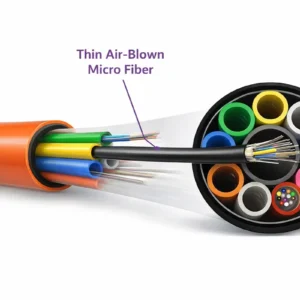
A micro/ROC flat drop is a slim, easy-access FTTH subscriber cable. Its flat 3.0×5.1 mm profile passes small conduits and tight building penetrations; G.657A1/A2 fiber maintains low loss at tight corners.
Two variants share one platform:
- Dielectric: fully non-metallic (dual FRP), no bonding/grounding.
- Toneable: same structure plus toning conductor for route locating after installation.

Where It’s Used
- Distribution terminal to ONT/ONU (FTTH/FTTP last-mile)
- Outdoor-to-indoor transitions in MDUs/SDUs, wall penetrations, ONT closets
- Duct/jetting and direct-buried pathways; light aerial spans with suitable hardware
- Retrofits where space is limited and quick access matters
Key Benefits
- Two variants, one platform: Dielectric for all-dielectric routes; Toneable when post-install locating is required.
- Small OD, fast access: speeds prep, slack storage, and device turn-up.
- G.657 bend-insensitive fiber: low loss around tight bends.
- Dual FRP strength members: consistent tensile & crush performance.
- Versatile deployment: duct/jetting, direct-buried, aerial (light spans), outdoor-to-indoor.
- Connector flexibility: bulk, field-terminated, or factory pre-terminated (hardened form-factor).
Construction Overview
- Fiber: Single-mode OS2, G.657 A1/A2 (other ITU types on request)
- Strength members: 2 × FRP in parallel for tensile and anti-crush performance
- Jacket: durable, easy-access outdoor sheath (HDPE or equivalent); indoor transition sheaths optional
- Toneable option: integrated toning conductor (copper/CCA) for route locating (non load-bearing)
Dielectric vs. Toneable (Quick Comparison)
| Category | Dielectric | Toneable |
|---|---|---|
| Locate/trace | External toner required | Integrated tone wire for route locating |
| Grounding | Not required | Not required (tone wire is for locate only) |
| OD/Weight | Base micro profile | Slightly higher (tone wire profile) |
| Use cases | General FTTH drop, aerial/duct/indoor | Direct-buried/duct where future locating is expected |
Specifications (typical 3.0×5.1 mm build*)
*Lock final figures to your drawing/BOM before publishing.
Dimensional & Materials
| Item | Dielectric | Toneable |
|---|---|---|
| Overall size | 3.0×5.1 mm (±0.1) | Base 3.0×6.6 mm (±0.2) |
| Fiber | OS2, G.657 A1/A2 | OS2, G.657 A1/A2 |
| Strength members | 2 × Ø1.2 mm FRP | 2 × Ø1.2 mm FRP |
| Jacket | Black outdoor grade (e.g., HDPE) | Same |
| Weight | ≈ 14.5 kg/km | Slightly higher |
Mechanical & Environmental
| Parameter | Value (both variants unless noted) |
|---|---|
| Bend radius | Dynamic 20 D / Static 10 D |
| Tensile (long/short) | 400 N / 700 N |
| Crush (long/short) | 300 / 1000 N per 100 mm |
| Temperature | −40 °C to +70 °C operate/store; −20 °C to +60 °C install |
| Water blocking | Dry or gel-free options (by model) |
| Standards | IEC 60794-1 family; RoHS/REACH materials |
D = cable overall diameter/width reference; follow the higher dimension when calculating MBR for flat profiles.
Installation & Routing Guidelines
- Duct/Conduit: Use a suitable pulling eye or jetting kit; respect dynamic bend radius ≥20 D during pulls.
- Direct-Buried: Follow local depth/backfill codes; Toneable simplifies post-install locating.
- Aerial: Use approved clamps/suspension hardware; observe span/tension guidance for light aerial drops.
- Outdoor-to-Indoor: Seal wall penetrations; transition to flame-retardant indoor cable or fire-stop fittings as required.
- Termination: Hardened pre-term ends minimize craft time; for field termination, follow cleave/connector MBR limits.
Options & Compatibility
- Lengths: standard reels and cut-to-length (meters or feet)
- Ends: bulk, field connectorization, or factory pre-terminated (hardened form-factor) to SC/APC, SC/UPC, etc.
- Color & Marking: black outdoor jacket; custom print & meter marking on request
- Kits: pulling eyes, jetting accessories, tone-wire termination kits (Toneable)
Accessories & Packaging (recommended to show on page)
- Accessories: wall penetration glands, aerial clamps/suspension, slack-storage trays, hardened connector dust caps
- Packaging: plywood or plastic reels; sequential meter marks; label with part number/length/fiber type; optional palletization
Ordering Information (example code)
MFD-[D/T]-1F-OS2-G657A2-3.0x5.1-FRP-HDPE-BK-Lxxx-[END]
- D/T: Dielectric or Toneable
- Lxxx: length (e.g., L150m, L500ft)
- END: Bulk / SCAPC-Hardened / SCUPC-Hardened / Pigtail-SCAPC, etc.
FAQ
Q1. Is “micro flat” the same as “ROC-style” drop?
Yes—both describe reduced-OD, easy-access flat FTTH drops; “ROC” often names the reduced outer dimension family.
Q2. When should I choose the Toneable variant?
For direct-buried or long duct runs where you’ll likely need to locate/trace the cable later.
Q3. Does the tone wire carry load or affect optical performance?
No. The tone wire is for locating only and is not a strength member.
Q4. Can it be used aerially?
Yes, for light aerial spans with appropriate clamps/suspension hardware and within tension limits.
Q5. What minimum bend radius should I observe?
Use ≥20×OD during installation and ≥10×OD in operation (or the manufacturer’s specific limit if higher).
Q6. Do you offer factory-terminated hardened ends?
Yes—dual-ended or pigtail configurations to SC/APC or other interfaces for faster turn-up.
Q7. CPR/flame rating for indoor transitions?
Base jacket is outdoor grade; for indoor sections choose LSZH/CPR-rated transition cords or use proper fire-stop fittings.