Description
When you deploy FTTR (Fiber-to-the-Room), the real challenge is not only getting fiber into every room—but also delivering stable DC power to room devices (APs, terminals, mini-ONTs) without adding visible AC wiring.
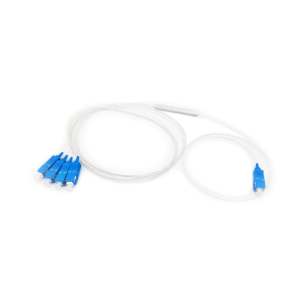
AIMIFIBER’s Active Optical Splitter (PoF Router) combines optical signal distribution + DC power distribution in one compact unit. It uses standard SC-type optoelectronic hybrid ports, supports unequal split ratios (1:5 / 1:9) for FTTR branching, and is designed for multi-stage cascade (daisy-chain) so you can expand room-by-room with consistent cabling rules.
What it is (and why it matters for FTTR)
Active Optical Splitter (PoF Router) is a PoF (Power over Fiber) distribution device used between the main FTTR gateway/central node and room endpoints. It:
- Splits the optical signal using an unequal ratio (1:5 or 1:9) optimized for practical room distribution
- Delivers DC power to each output port through the same hybrid connection
- Protects connected devices with built-in power management and protection logic
- Supports daisy-chain expansion (multi-stage cascade) for villas, apartments, hotel rooms, and retrofit projects
If your target customer cares about “no wall damage, no trunking, clean installation, and fast rollout”, this is the core box that makes the PoF-style FTTR architecture work.
Key features (for engineers & installers)
- Standard SC optoelectronic hybrid ports
One interface for fiber + power distribution in the FTTR PoF ecosystem. - Unequal optical split (1:5 / 1:9), multi-stage cascade
Practical branching for FTTR room distribution; supports expanding the network by cascading. - Short-circuit detection & protection
Automatically detects abnormal line conditions and protects the system. - Port overload protection (per-port breaker logic)
Designed to protect the powered endpoint devices; power capacity depends on the selected power supply configuration. - 4KV lightning surge protection
Improves reliability in real residential/MDU electrical environments. - Reverse polarity protection
Protects equipment against positive/negative miswiring. - Auto detect & dynamic power allocation
Helps the system distribute output power more safely and consistently.
Typical use cases
- High-end residential FTTR retrofit (no trunking / minimal drilling)
- Apartments / MDUs needing fast, standardized indoor fiber + powered endpoints
- Hotels, serviced apartments, office upgrades requiring clean aesthetics and predictable installation
- Room-by-room expansion projects where cascade topology reduces rework
Models & technical specifications
1) Optical & split performance (unequal split with cascade support)
| Split Ratio | Model Reference | Output Port IL (Max) | Cascade Port IL (Max) | Return Loss |
|---|---|---|---|---|
| 1:5 | OPS-HS1205-SC/UPC | ≤ 15.6 dB | ≤ 1.8 dB | ≥ 50 dB |
| 1:9 | OPS-HS1209-SC/UPC | ≤ 16.5 dB | ≤ 2.3 dB | ≥ 50 dB |
Fiber type (system reference): G.657A2
Wavelength range (system reference): 1260–1650 nm
Connector interface: SC-type hybrid interface (UPC default; APC can be offered as an option when required by the project)
Notes for purchasing teams: 1:5 is typically used when you want a more conservative branching plan or fewer rooms per stage; 1:9 is used when you want maximum room coverage per stage with fewer devices.
2) Power & system parameters (PoF Router class)
| Item | Specification |
|---|---|
| Power input | External 48–57 V DC (power rating selectable by configuration) |
| Output | 56 V DC (system reference) |
| Protection | Short-circuit / overload / reverse polarity / surge protection |
| Installation | Wall-mounted |
| Port type | SC optoelectronic hybrid ports |
Per-port power capacity depends on the selected external power module and project design. If you want us to lock a guaranteed per-port wattage target, we will confirm it together based on: number of endpoints, cable length per branch, and device load profile.
3) 4-port vs 8-port chassis options
| Variant | Output Lines | Dimensions (H×W×D) |
|---|---|---|
| 4-port unit | 4 | 146 × 115 × 36 mm |
| 8-port unit | 8 | 190 × 115 × 34 mm |

Daisy-chain deployment (why unequal split helps)
In real homes and apartments, FTTR is rarely a perfect “one central point to all rooms” star topology. Renovation constraints force mixed routes.
This PoF Router supports cascade so you can:
- Feed a first stage (e.g., corridor / living room)
- Then extend to a second stage (e.g., bedrooms) without re-pulling everything
- Keep the same SC hybrid interface standard across the build
That is why the cascade port insertion loss is specified separately—it is critical for multi-stage planning and stable optical budgets.
Compatibility (typical FTTR PoF ecosystem)
This product is commonly used with:
- Photoelectric composite cables (hybrid fiber + power) for indoor FTTR routing
- Photoelectric composite adapters (SC/UPC, XC/UPC) to match different termination scenarios
- Room-level terminals / access boxes / compact endpoints in FTTR indoor networks
If you tell us your planned topology (rooms, cable lengths, endpoints), we can recommend the cleanest combination of:
split ratio (1:5 or 1:9) + 4-port/8-port chassis + adapter type + cable type.

Ordering options (OEM-friendly)
- Split ratio: 1:5 or 1:9
- Chassis: 4-port or 8-port
- Interface polish: SC/UPC (standard); SC/APC (optional) if your FTTR/PON design requires it
- OEM: logo, label, packaging, and documentation customization available
- Project support: topology suggestion + configuration checklist (so installers don’t guess on-site)
FAQ (for SEO / GEO + buyer decision support)
1) Is this a normal PLC splitter?
Not exactly. It’s an active PoF router that integrates optical splitting + DC power distribution + protection in one device, designed specifically for FTTR indoor PoF-style deployments.
2) What does “unequal split 1:5 / 1:9” mean in FTTR?
It refers to the internal optical distribution design optimized for room branching and cascade expansion, helping you balance optical budget and practical port planning.
3) Can I daisy-chain multiple units?
Yes. The system is designed for multi-stage cascade, which is common in retrofit FTTR where cable routes are constrained.
4) Do you offer SC/APC?
Standard configurations are commonly SC/UPC in this PoF ecosystem. If your network standard requires SC/APC, we can provide it as an option—confirm your mating interface requirements before ordering.
5) What power supply does it need?
It uses an external 48–57 V DC power supply. Power rating can be selected based on how many endpoints you plan to power and the required margin.
6) What protections are included?
Short-circuit detection/protection, overload protection logic, reverse polarity protection, and surge protection are included to improve safety and reduce field failures.
7) Where is it typically mounted?
Wall-mounted near the FTTR main node, corridor distribution point, or a concealed service area where branch routing starts.
8) Can you help confirm the split ratio and layout for a villa or apartment?
Yes. Send your room count, approximate cable lengths, and endpoint type (AP/terminal), and we will suggest a practical 1:5 vs 1:9 design and how many stages to cascade.