How to Choose the Right FTTH Patch Cord for Your Network
Choosing the right fiber optic patch cord is critical to minimizing insertion loss, ensuring return loss stability, and avoiding deployment errors in FTTH networks. For telecom operators, system integrators, and project managers—especially in CPR-regulated regions—mismatches in connector type, polish, or jacket construction can result in performance failures and costly rework.
Let’s walk through the decision-making framework I use in large-scale builds across Europe and LATAM.

What Connector Type and Polish Should You Use?
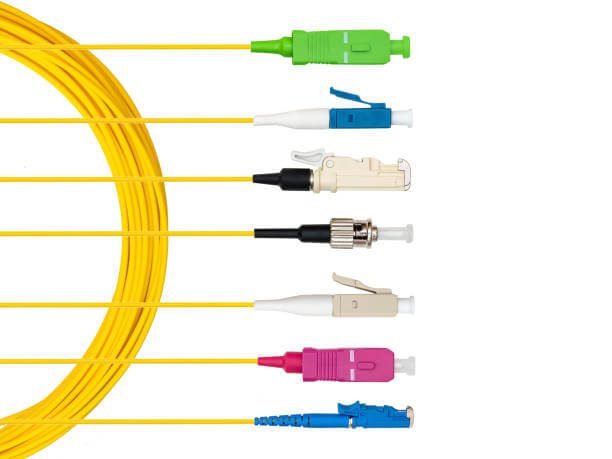
The most common connectors are SC and LC. In FTTH, SC/APC is dominant on the access side, while LC/UPC is ideal for data center interconnects and dense racks.
| Connector | Polish | Typical Use | IL (dB) | RL (dB) |
|---|---|---|---|---|
| SC/APC | APC | ONU, FTTH wall outlet | ≤ 0.3 | ≥ 60 |
| SC/UPC | UPC | OLT patching, ODF jumpers | ≤ 0.3 | ≥ 50 |
| LC/UPC | UPC | High-density racks, COs | ≤ 0.3 | ≥ 50 |
APC vs. UPC tip:
Green = APC (angled, lower reflection)
Blue = UPC (flat dome, direct contact)
🔗 Read more: APC vs UPC Polish Differences
Never mate APC with UPC. This causes return loss spikes and physical damage.
What Jacket and Cable Type Fits Your Installation?
Choose jacket structure based on mechanical protection, CPR fire compliance, and flexibility.
| Cable Type | Description | Best For |
|---|---|---|
| Simplex (2.0mm) | Single core, compact | ONU, outlet to wall patch |
| Duplex | TX/RX in one sheath | Indoor ONT/ODF patching |
| Armored | Steel tube + LSZH | Rodent/dusty/underground zones |
| LSZH jacket | CPR-compliant, low smoke | Indoor Euro deployments |
EU Install Tip: For indoor use in Europe, select CPR Cca or higher + LSZH jacket to comply with EN 50575.
🔗 [Explore CPR-Compliant Cable Types](https://aimifiber.com/read-eu-cpr-lszh-test-report/ )
%
What Specs Must Be Verified Before PO?
Before issuing a purchase order, verify the following:
- Insertion Loss (IL): ≤ 0.3 dB typical. Tighter specs ≤ 0.2 dB available on request.
- Return Loss (RL): ≥ 60 dB (APC), ≥ 50 dB (UPC).
- Ferrule Geometry: Must pass 3D interferometer inspection (radius, apex offset, fiber height).
- Endface Cleanliness: Test reports should include IEC 61300-3-35 Grade A photos.
- CPR Declaration of Performance (DoP): Mandatory for indoor projects within the EU.
🔗 How to Reduce Return Loss in FTTH
Recommended Patch Cords from AIMIFIBER
| Location | Product | Features |
|---|---|---|
| ONU → Wall Plate | SC/APC–SC/APC simplex, G657.A2 | Angled polish, bend-insensitive, green boot |
| ODF → OLT | SC/UPC–LC/UPC patch | Hybrid polish, factory tested IL/RL |
| Rack Patch Panel | LC/UPC–LC/UPC duplex | 1.6–2.0mm duplex, color-coded, high-density |
| Harsh Areas | SC/APC armored simplex | Crush/rodent resistant, water-tight, CPR Cca+ |
🔗 Browse AIMIFIBER Patch Cord Catalog
FAQs
Q1: Can I mix SC/UPC and SC/APC cables?
A: No. Mixing polish types results in reflection, loss, and even laser instability.
Q2: What IL/RL values are acceptable for FTTH drop jumpers?
A: ≤ 0.3 dB IL, ≥ 60 dB RL for SC/APC. Ask for batch test reports.
Q3: Is armored cable necessary indoors?
A: Not usually. Only use armor where rodents, sharp bends, or foot traffic are expected.
Q4: What CPR class is required for indoor use in EU?
A: At least Cca-s1a,d1,a1 for common buildings. Check EN 50575 + local regulation.
Q5: How to verify jumper compliance?
A: Ask for:
- IL/RL test sheet
- 3D interferometer result
- Endface scope photos
- DoP (Declaration of Performance) if CPR rated
Final Thoughts
If you're running a tender or managing a rollout, define the patch cord spec by:
- Connector & polish match
- CPR & jacket type for region
- Certified IL/RL and geometry data
📩 Need help matching the correct cable to your BOM?
Email sophie@aimifiber.com or visit AIMIFIBER Patch Cord Catalog.