How to Read a CPR and LSZH Test Report for FTTH Cables
Placing a large order for FTTH cables in Europe? You likely worry about strict regulations. A non-compliant cable can cause customs delays, project failures, and significant financial losses, turning a promising project into a nightmare.
To correctly read a CPR/LSZH test report, first verify the Euroclass rating matches your project's needs. Then, check that the cable description, manufacturer details, and test date are correct and validated by an official EU notified body.
I remember a client in Spain, Fernando, who was managing a large telecom project. He almost accepted a shipment based on an outdated CPR report for a different cable batch. We caught the issue just before the PO was issued, saving his company from a major compliance headache.
What Exactly is the EU's Construction Products Regulation (CPR)?
The CPR can seem complex, but its purpose is straightforward. It’s a set of rules that governs products used in construction, including the fiber optic cables we install inside buildings.
CPR is a regulation that sets mandatory fire safety standards for all cables, including fiber optics, permanently installed in EU buildings. It ensures safety and product consistency across the market.
This regulation has been in effect since July 1, 2017. For us in the fiber optic industry, it means every cable permanently installed in a building must meet specific fire performance standards.
What Do the Different Euroclass Ratings Mean?
Raw Materials: LSZH TPU PVC PEEU building equipped with fiber optic cables that comply with CPR’s fire safety standards, showing safe, standardized installation.
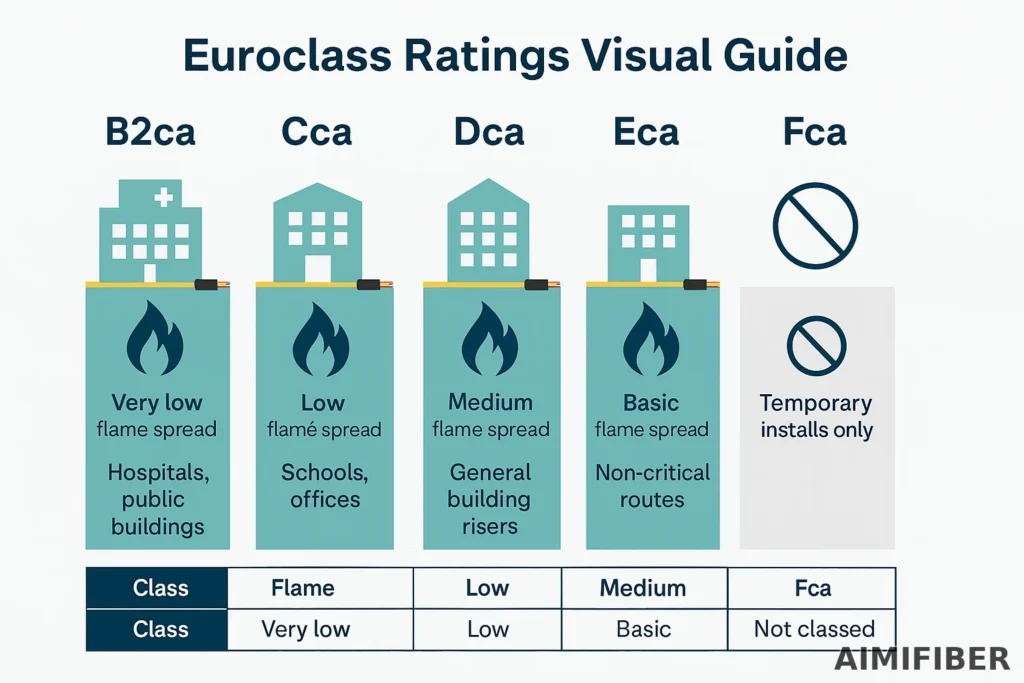
Euroclass ratings (like B2ca, Cca, Dca) classify a cable's fire performance. B2ca offers the highest safety with very low flame spread, while Eca is for basic, non-critical applications.
The rating also includes sub-categories for:
- Smoke production (s) —
s1= low smoke;s3= high smoke - Acidity (a) —
a1= low acidity; better for protecting equipment - Burning droplets (d) —
d1= minimal flaming droplets
Euroclass Comparison Table
| Class | Flame Spread | Smoke (s) | Acidity (a) | Droplets (d) | Typical Use |
|---|---|---|---|---|---|
| B2ca | Very Low | s1 / s2 | a1 / a2 | d1 / d2 | Hospitals, public areas |
| Cca | Low | s1 / s2 | a1 / a2 | d1 / d2 | Schools, offices |
| Dca | Medium | s2 / s3 | a2 / a3 | d2 | Standard risers |
| Eca | Basic | – | – | – | Non-critical runs |
| Fca | Unclassified | – | – | – | Temporary runs |
How to Read a CPR Test Report (Checklist)
Always verify these before accepting delivery:
- ✅ Euroclass matches spec (e.g., Cca s1 d1 a1)
- ✅ Cable ID/part number matches PO
- ✅ Manufacturing batch or DoP # matches shipment
- ✅ Test date is recent (<2 years)
- ✅ Report issued by notified body (with NB ID)
- ✅ CE mark and DoP on packaging
- ✅ Fire test standards include EN 50575
What About LSZH?
Many buyers confuse LSZH with CPR compliance.
- LSZH (Low Smoke Zero Halogen) is a material property.
- CPR is a legal requirement with Euroclass fire performance.
A cable can be LSZH but still fail to meet CPR B2ca or Cca standards.
So: Always ask for both CPR certificate and LSZH material spec.
Frequently Asked Questions (FAQ)
❓ Is CE marking enough to ensure CPR compliance?
No. CE marking must be accompanied by:
- Declaration of Performance (DoP)
- Euroclass rating
- Notified body number
❓ What's the minimum CPR class for indoor FTTH cables?
- Public buildings: Cca or B2ca
- Offices / MDUs: Minimum Cca
- General risers / small buildings: Dca or above
❓ Can I rely on supplier brochures alone?
No. Always request the official CPR certificate and DoP for each ordered batch.
Final Thoughts
Properly reading CPR and LSZH test reports is a critical skill. It protects your project from:
- 🔥 Fire safety risks
- 🚧 Customs or on-site rejections
- 💰 Financial losses from non-compliance
A 10-minute CPR review can save weeks of costly rework.
Written by Sophie Wang, FTTH deployment specialist at AIMIFIBER. If you need CPR-certified indoor cables, drop us a line.